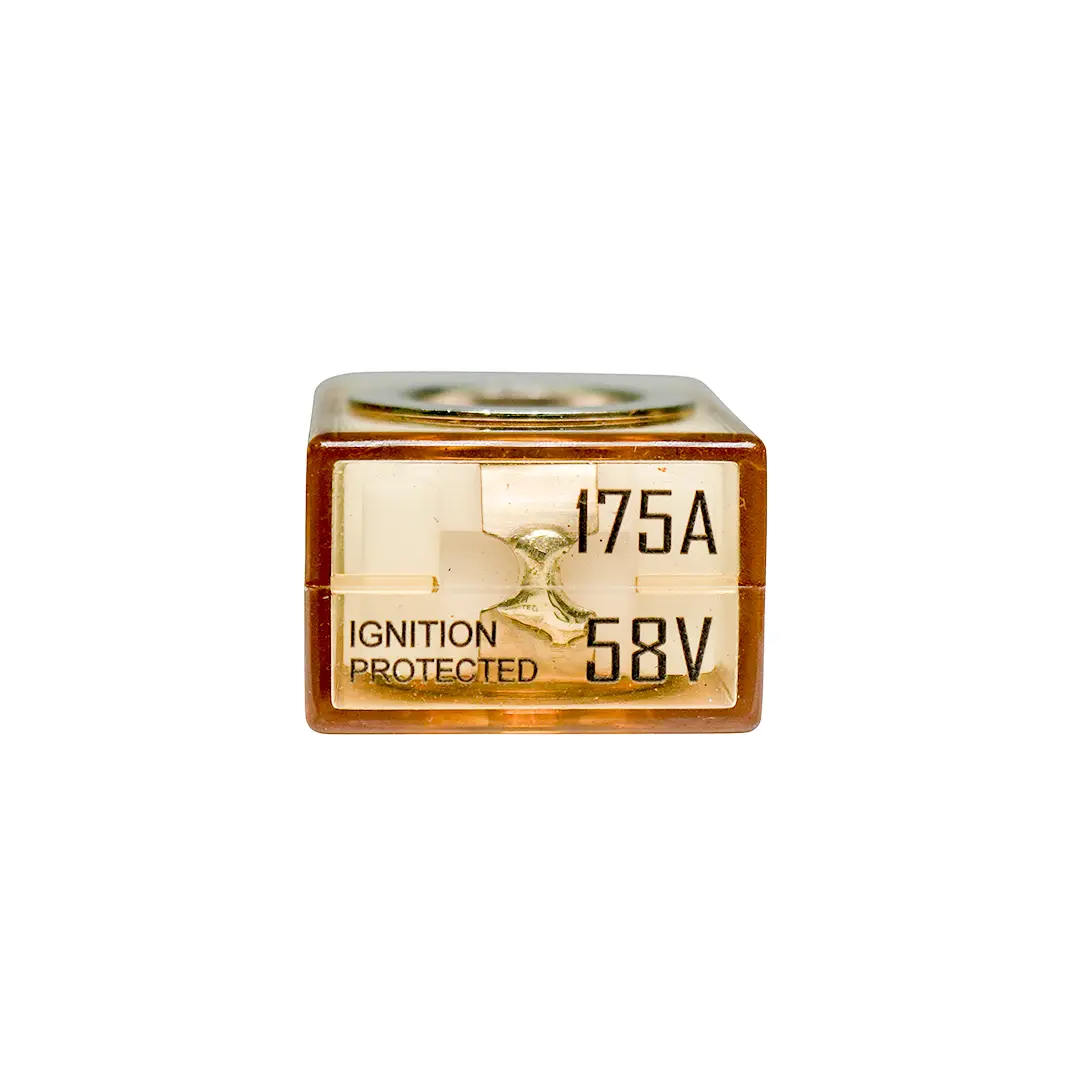


Alvolta 175A Battery Terminal Fuse (MRBF)
Ignition-protected battery terminal fuse for systems up to 58 V

Alvolta 175 A Battery Terminal Fuse
Features
- 175 A
- Ignition protected
- Suitable for systems up to 58 V
- Secure bolt-in connection
- Corrosion-resistant connector blades
- Power distribution protection
- Compact size
- Colour-coded for each amperage
- 'Blown fuse' window
- Perfect for fusing dual battery systems
Where to use it
These fuses are designed to connect as close as possible to the positive terminal of a battery to protect the wiring from overcurrents and short circuits.
Pair with
These fuses pair best with an Alvolta Battery Terminal Fuse Holder.
Fuse Guides


Dimensions
Length | 27.8 mm |
Width | 23 mm |
Depth | 16.3 mm |
Weight | 0.09 kg |
Safety certifications
- SAE J1171
Applications

Marine

RV's

Caravans

Off-Grid Systems

Tiny Houses

Cabins
About Alvolta
Australian-owned and operated and driven by a passion for excellence, Alvolta offers unwavering performance and durability even in harsh Australian conditions. Alvolta specialises in precision-engineered DC components, designed to enhance off-grid adventures. Their commitment to delivering superior power performance with uncompromising quality is evident in their lineup of solar panels, solar charge controllers, circuit protection devices, mounting solutions, tools, and more. Supply yourself with all the arsenal you need to extend your power supply and adventure for longer with Alvolta.